

How to clean and cut the pineapple
With this Cooking School, you will be able to clean and cut the pineapple easily and quickly, to prepare desserts, compositions, and savory dishes!
- 0 min
- Kcal 144
Eggplants, or melanzane, are a big deal in Southern Italian kitchens—especially in colorful places like Naples. They’re just essential. Really, you can't go wrong with these veggies in traditional dishes. Choosing the right type? That’s key. The round, deep purple ones are perfect for crispy frying, while those longer, thinner ones are so so good in Neapolitan stuffed recipes.
So here's the thing about how to clean eggplant. It's not just rinsing. You gotta avoid overripe ones—trust me on this—because they can be bitter and not very enjoyable. Late summer is the time to snag them for their freshest, tender texture. Seriously good.
There are all kinds of shapes and colors, so knowing how to cut eggplant really depends on your dish—thicker slices for grilling, long strips for stuffing, or cubes for some classic Sicilian caponata. In the beautiful regions of Southern Italy, preparing eggplant involves giving them a good scrub to get rid of dirt and then slicing them precisely. Old-school cooks will tell you to salt the pieces first to draw out extra water and cut the bitterness.
Mastering eggplant preparation methods includes optional peeling—depends on how soft you want your dish. Leaving the skin on? Adds a tangy flavor, for sure. Cutting them into different shapes can change up the texture—think golden, pan-fried rounds for pasta alla Norma or diced bits for hearty stews.
With the right cutting techniques, your eggplant will cook evenly and soak up those Italian sauces beautifully. Honestly, this versatile veggie is fun to experiment with. Once you get the hang of cleaning and cutting, you'll see why Southern Italian recipes love it. Whether you're making a classic or something new, these eggplants bring a taste of Italy straight to your kitchen.
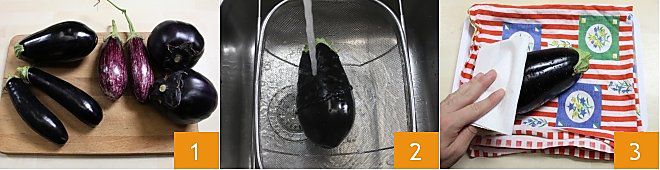
First of all, make sure the eggplant's texture is firm, the skin is shiny and smooth, without dents or brown spots, and that the weight is proportionate to its size. The quality of the eggplant, in fact, determines the success of your dish. Despite there being different types: round, oval, oblong, and long 1, all eggplants are cleaned in the same way. So, wash the eggplant thoroughly under running water 2 and dry it with a cloth 3.

Then remove the stem, which can sometimes be thorny, with a knife 4, and if you prefer, also remove the base, though you should keep it if, for example, you want to prepare stuffed eggplant. In most traditional Italian recipes, the skin is not removed. If you want to peel it, get a vegetable peeler or a knife, and cut the skin while holding the eggplant with the narrower end facing up, removing the skin from top to bottom 5, until the eggplant is completely peeled 6.

It is important to remember that eggplant should be peeled right before use because it tends to blacken very quickly. To avoid this inconvenience, you can squeeze some lemon juice on the peeled and sliced eggplant 7. If you want to eliminate the bitter taste, excess water, and make it sweeter, salt the eggplant before cooking. After washing it, slice it and place the slices in a colander, where you will sprinkle them with coarse salt 8. Then cover them with a plate or a tray 9 and place a weight on top to facilitate draining.
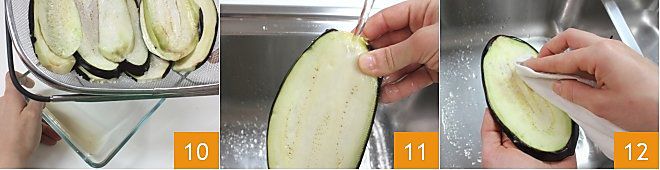
Let them drain for about 2 hours, so that part of the bitter liquid is released 10. After that, rinse each slice 11 and pat them dry with a cloth 12. Of course, in this case, the eggplant will be saltier.
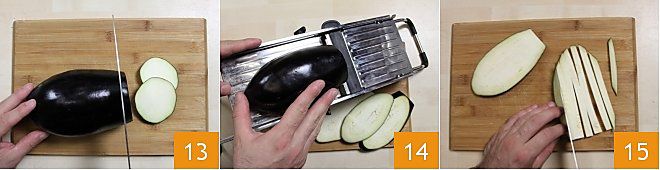
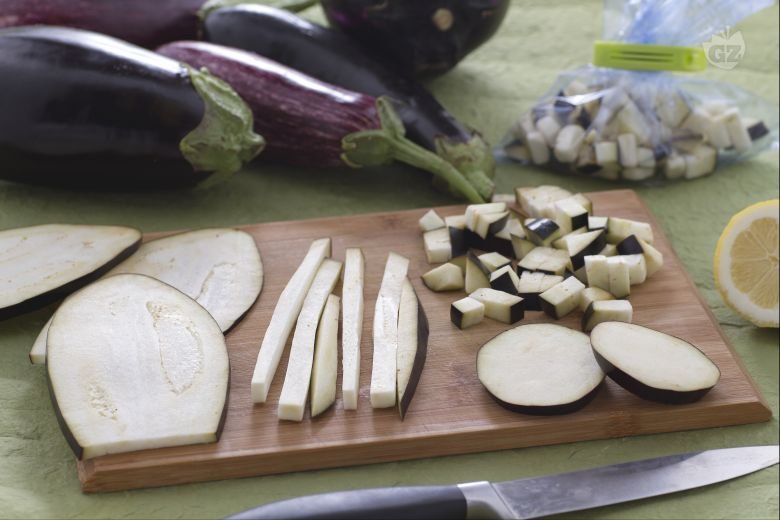
The way you cut the eggplant depends on the dish you intend to make, so there are different methods. To cut the eggplant into rounds, place the cleaned eggplant horizontally on a cutting board or surface, and slice it into rounds of your preferred thickness 13. Usually, the ideal thickness is about 1/2 inch. This cut is suitable for grilling preparations. To cut the eggplant into longitudinal slices, use a mandolin and slice the eggplant with a thickness of a few millimeters for a carpaccio or about 1/2 inch for breading and frying 14. If you don't have a mandolin, you can perform the same operation with a knife. If you want to slice the eggplant into sticks, for preserving in oil, cut it longitudinally into regular slices, stack the slices, and cut them lengthwise to form sticks of your preferred size 15.
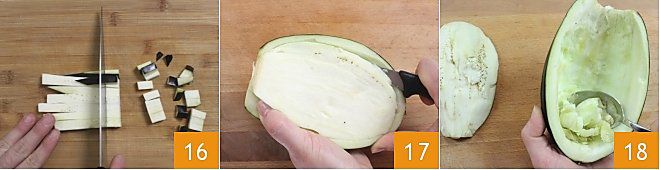
Starting from the stick cut, you can make the dice cut, to prepare pastas or risottos: arrange the sticks you formed and then cut them widthwise. The size of the dice varies depending on the preparation: 1/2 inch is ideal for pastas or risottos 16. If you want to prepare stuffed eggplant, cut it in half lengthwise or widthwise according to your preference, and score the flesh with a paring knife, leaving a 1/2 inch border from the skin 17. Then scoop out the flesh with a spoon 18.
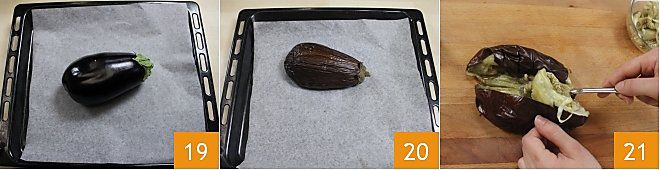
To make eggplant meatballs or eggplant caviar, for example, you need to scoop out the flesh after baking the eggplant. Cover a baking sheet with parchment paper and place the whole eggplant on top after washing it 19. Bake for a time that varies depending on the preparation, until it reaches a soft and roasted consistency 20. Once cooked, cut it in half and scoop out the flesh with a spoon 21.