


Saint Honoré Cake with Sponge Cake
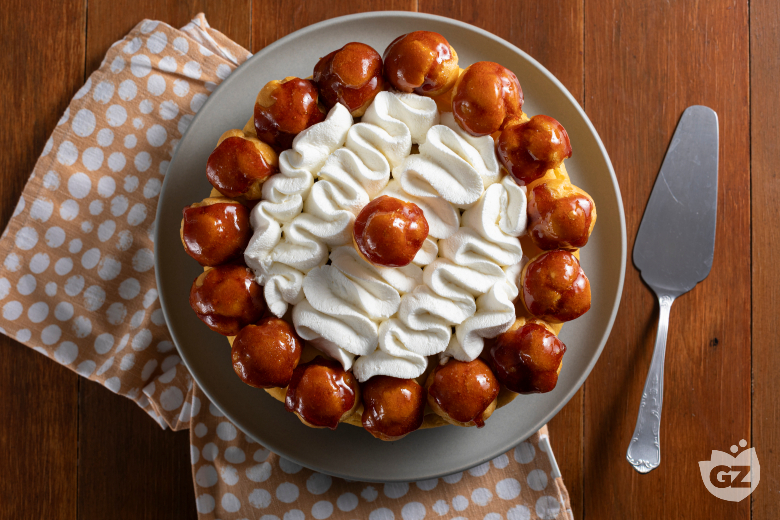
The Saint Honoré cake with sponge cake is a dessert inspired by the classic French version, soft and crunchy, it will win over your guests
- Difficult
- 4 h 25 min
- Kcal 641
The Saint Honoré cake—oh man, it's a show-stopper—is perfect for any celebration. Seriously, it looks amazing and has this intricate design that just wows everyone. So, let's talk history: This delightful French pastry dessert comes from Paris, named after Rue Saint-Honoré, and was whipped up in the 19th century by the genius pastry chef Chiboust. I mean, we're talking about a dessert that blends tradition with sophistication.
At its base, you’ll find a crispy puff pastry layer. Really good stuff. On top, delicate rounds of choux pastry sit pretty—some filled, others just baked—all dipped in golden caramelized sugar. They form this regal crown around the edges. And the inside? It's a dreamy mix of smooth whipped cream and creamy Chiboust cream—a blend of pastry cream and Italian meringue. Each bite offers a good mix, I gotta say: tender choux, crispy caramel, layers of sweet richness that just dance on your taste buds. Pretty awesome.
In the world of French baking techniques, you have other stars like Tarte Tropezienne, Savarin, Paris-Brest, and Croquembouche. But honestly, the Saint Honoré cake recipe really really stands out. It’s for those who are brave enough to invest time, patience and a bit of daring in the kitchen. Here’s the deal, though: It is not just about looks. The flavor profile, with its soft choux pastry, silky Chiboust cream, and tangy caramelized sugar, leaves such a lasting impression.
The mix of textures—moist filling, crisp layers, and sweet topping—creates a memorable experience. Whether you love a traditional French dessert or want to test your pastry skills, this cake gives you that impressive wow factor and a taste of Parisian baking culture. It's a delicious challenge that captures the essence of French pastry art, making it a must-try for any dessert enthusiast. For real, you can't go wrong.
You might also like:
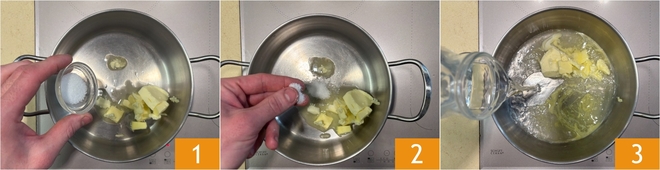
To prepare the Saint Honoré cake, first focus on the choux pastry: in a pot, put the butter, sugar 1, and a pinch of salt 2. Pour in the water 3 and completely melt the butter over medium heat.
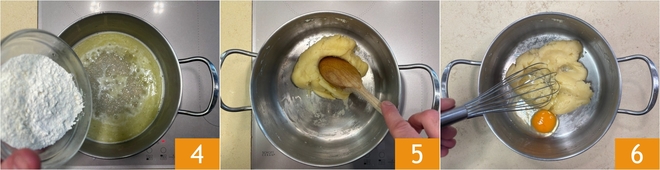
When the mixture is about to boil, add the flour 4 and, with a wooden spoon, stir vigorously until a white film forms on the bottom. Remove the pot from the heat and let the mixture cool while stirring continuously with a wooden spoon (alternatively, you can use a stand mixer with a paddle attachment). When the choux pastry is warm, add one egg at a time 6, incorporating it with the whisk.
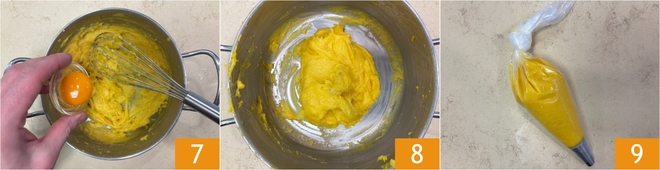
Finally, add the egg yolk 7. Once you have the choux pastry 8, transfer it into a piping bag fitted with a plain 13 mm (approximately 1/2 inch) nozzle 9.
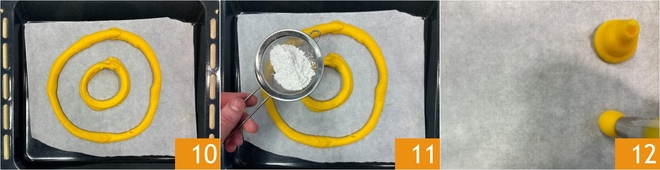
On a baking sheet lined with parchment paper, draw with a pencil a circle of 20 cm (approximately 8 inches) in diameter and one of 10 cm (approximately 4 inches) in diameter, then turn the sheet over and follow the outline by squeezing the choux pastry with the piping bag 10. Dust the rings with powdered sugar 11. On another baking sheet lined with parchment paper, pipe dollops to make 16 cream puffs 12.
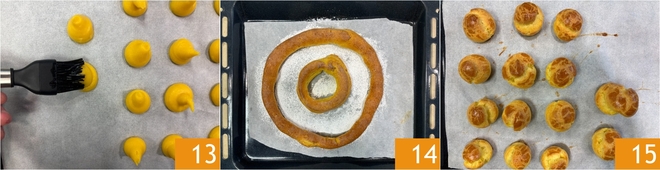
Use your finger to wet the tips of the cream puffs with the beaten egg white, then brush them 13. Bake both the circles and the cream puffs in a preheated static oven at 356°F (180°C) for 30 minutes 14 15. You can bake the trays separately or simultaneously: in the second case, swap their positions halfway through baking.
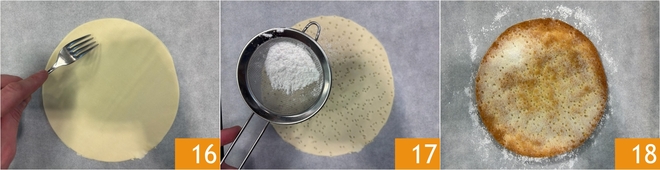
Roll out the puff pastry and cut out a disc with a diameter of 22 cm (about 8.5 inches). Place it on a baking sheet covered with parchment paper and prick it with the prongs of a fork 16. Dust with powdered sugar 17 and bake in a static oven at 356°F (180°C) for 25 minutes 18.
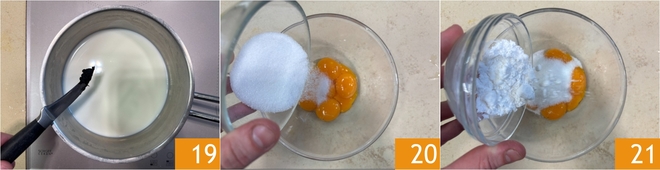
To prepare the chiboust cream, start with the pastry cream: first, soak the gelatin sheets. In a saucepan, pour the milk and the seeds of the vanilla bean 19, then heat over low flame until it almost boils. Meanwhile, in a bowl, combine the egg yolks, sugar 20, and cornstarch 21, then quickly work with a whisk to mix the ingredients without whipping them.
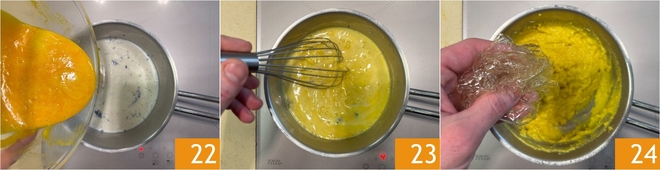
Add the yolk mixture to the hot milk in the saucepan 22 and stir continuously over the heat until the cream resumes boiling 23. At this point, turn off the heat and add the well-squeezed gelatin sheets 34.
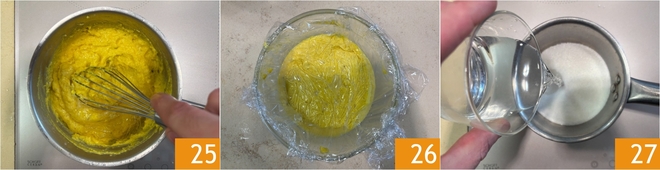
Stir until evenly incorporated 25. Transfer everything to a bowl and cover with cling film directly on the surface 26. Let it cool first at room temperature and then in the refrigerator for an hour. Proceed to the Italian meringue: in a saucepan, pour the sugar and water 27 and dissolve it over medium-low heat.
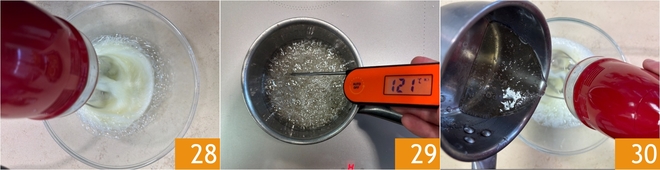
In the meantime, begin to beat the egg whites until stiff 28. When the syrup reaches 250°F (121°C) 29, pour it slowly into the egg whites 30 and continue to beat until the mixture cools down. The meringue will be ready when it becomes glossy, and when you lift the whisk, it forms a peak, the so-called 'beak'.
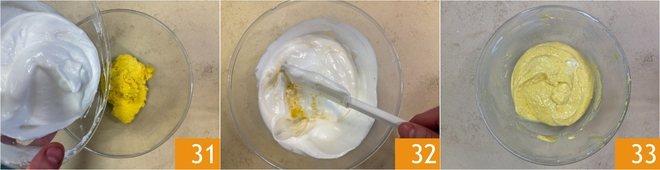
Take the pastry cream from the refrigerator and soften it with the whisk, then add the meringue in 2 or 3 batches 31 and mix from bottom to top 32 to incorporate it evenly 33. Transfer the chiboust cream into a piping bag fitted with a 12 mm (approximately 1/2 inch) nozzle and keep it in the refrigerator until ready to use.
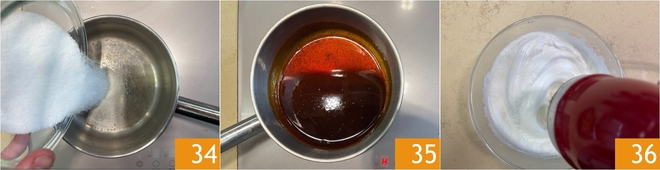
To prepare the caramel, pour the sugar into a saucepan 34 and melt it over medium heat 35. In a bowl, whip the fresh cream with powdered sugar 36. Transfer the whipped cream into a piping bag fitted with the typical Saint Honoré tip and keep it in the refrigerator until ready to use.
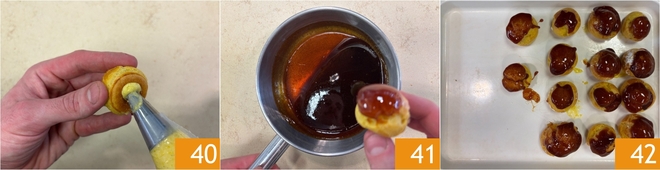
Before assembling the cake, focus on filling the cream puffs: make a hole at the base and fill them with cream by inserting the tip of the piping bag 37. Dip the tops of the filled cream puffs in the caramel 38 and lay them on a tray to dry 39.
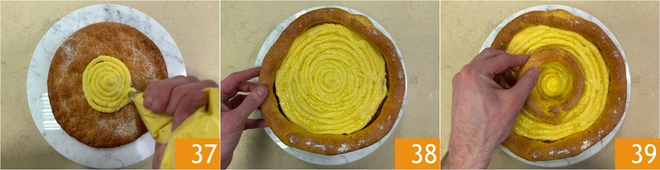
At this point, place the puff pastry disc on a serving plate and cover it with the cream in a spiral 40. Position the choux pastry circles on the cream, one on the outer edge 41 and one inside 42. Then fill the spaces with the remaining cream to reach the same level as the rings.
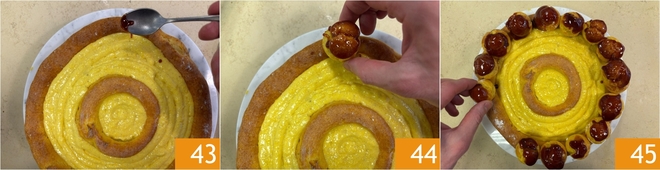
Place the cream puffs on the outer choux pastry disc, using a drop of caramel at the base to keep them in place 43 44. Continue in this manner until the entire edge is covered 45.
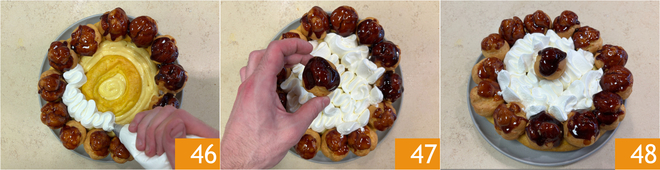
Finally, decorate the top with whipped cream 46 and place the last cream puff in the center 47. Put your Saint Honoré cake in the refrigerator for 2 hours to solidify before serving 48!