
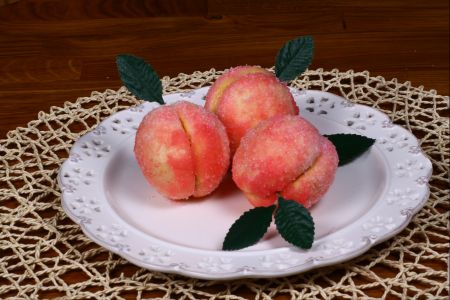
Fake peaches with alchermes
Is it no longer peach season? No problem! Try making fake peaches with alchermes! A simple and delicious treat that will win you over!
- Average
- 45 min
- Kcal 346
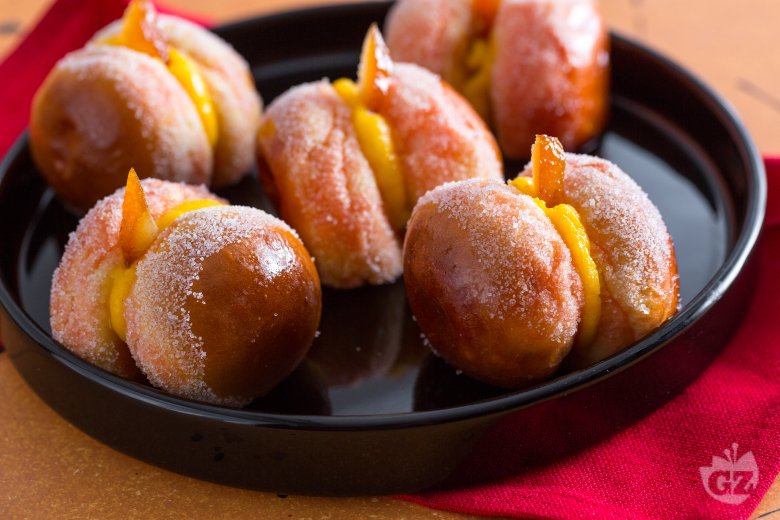
Prato peaches are this really tasty treat straight out of Tuscany, and they bring such a delightful touch of Italian tradition to your table. Known as Pesche di Prato, they are a true gem of Tuscan baking. They look like peaches but surprise you with super soft, really moist brioche buns filled with smooth custard cream. And here's the thing—the magic's in their soak in Alkermes liqueur—you know, that bright red syrup? It infuses a sweet, herby aroma, giving the peaches their main pink hue. You'll see this liqueur in other Tuscan desserts like zuppa inglese, adding that distinctive twist. After soaking, each bun gets rolled in sugar, which is great—giving it a crispy exterior that contrasts beautifully with the creamy center. Prato locals are super proud of this treat, and it is easy to see why. Honestly, it's proof of their culinary skill, just like the beloved schiacciata fiorentina.
A weekend stroll through Tuscany? Pretty incomplete without a box of these Italian brioche dessert classics. The mix of tender pastry and the boozy, floral Alkermes makes them stand out in the world of custard-filled brioche. The interplay between the sweet cream and that slightly spicy, perfumed syrup is just unexpectedly tasty. Often seen as a secret shared by Prato's master pastry chefs, these peaches are perfectly balanced—not too heavy or sugary. They've got a festive look, but aren't just for special occasions; locals enjoy them as everyday snacks too. Deeply rooted in Prato's culinary traditions, Pesche di Prato gives you a real taste of Tuscan baking—where age-old flavors blend with a touch of kitchen magic. Every bite feels like a celebration—especially for those who love Italian sweet recipes or want to explore authentic Tuscan dessert specialties. With each mouthful, you're not just tasting a dessert but really experiencing a piece of Tuscan culture. For sure, they're a must-try for anyone passionate about regional Italian cuisine.
You might also like:
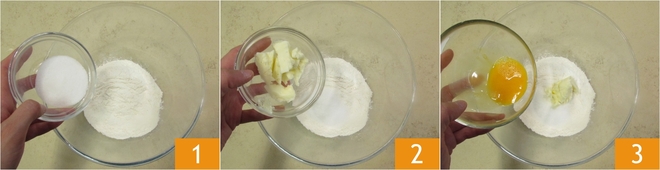
To make Prato peaches, start with the biga: in a bowl (or in a stand mixer with a hook), add the flour, sugar 1, butter 2, and egg 3.
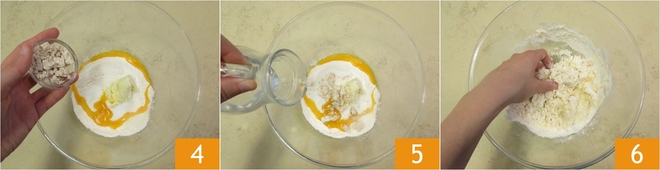
Also add the crumbled yeast 4 and most of the water 5. Mix to combine the ingredients 6. If the mixture seems a bit too stiff, you can add the remaining water. Do not overwork the dough; the important thing is that it is homogeneous.
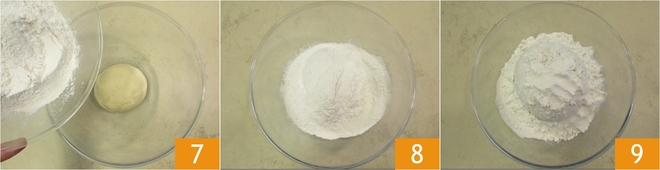
Form a ball and cover it with the 2.75 cups of flour needed for the second dough 7, then let it rise for 1-1.5 hours 8; this way, no skin will form on the surface. During the rising time, the biga should almost triple in volume 9.

Pour the biga with all the flour into the bowl of a stand mixer fitted with a hook 10, then add the sugar 11 and butter 12.

Also add almost all the eggs 13, the honey 14, and the salt 15.

Flavor with grated orange zest 16 and vanilla bean seeds 17. Set the mixer to low speed to combine everything 18, then decide if you want to add a little more eggs based on the consistency of the mixture, which should be homogeneous and not too hard. Continue mixing with the mixer until you no longer hear the sound of the dough slapping against the bowl. At this point, you can increase the speed and continue mixing until the dough pulls away from the sides and is smooth, dry, and well-developed.

Check that a gluten mesh has formed by taking a small piece of dough and stretching it between your fingers: if it doesn't tear and is elastic and transparent, it's ready 19. Use a dough scraper to transfer the dough to the work surface 20, then shape it with your hands. Place the dough in a bowl, dust with flour 21, and let rise for about an hour and a half, covered with plastic wrap or a cloth; it should double or triple in volume.

After the rising time 22, transfer the dough to a lightly floured work surface and divide it into 5 portions of about 3.5 oz each 23. Shape each piece into a regular loaf and divide each loaf into 8 equal parts weighing about 0.4 oz each 34.

Shape small balls on the work surface without adding flour 25, then place them on a baking tray lined with parchment paper, spacing them apart 26. Press them lightly, starting with the first one 27.

Let them rest for 10 minutes, then press them again; this way, the balls will grow into a hemispherical shape 28. Cover the baking tray with plastic wrap (or cloth) and let rise for about 2 hours; they should almost triple in volume 29. Bake the balls in a preheated static oven at 392°F for 6-7 minutes; when they have a honey-hazel color, remove from the oven and let cool 30.

To prepare the pastry cream, pour the milk and cream into a saucepan 31, then flavor with 2-3 pieces of lemon zest 32 and the seeds of half a vanilla bean 33.

Add half of the sugar 34 and heat everything over low heat. Meanwhile, pour the remaining sugar into another saucepan along with the sifted flour 35 and cornstarch 36.

Add the salt 37 and mix with a whisk. When the milk and cream mixture is warm, pour a small part onto the dry ingredients 38 and whisk vigorously to remove all lumps 39. Meanwhile, return the saucepan to the heat to bring it to a near boil.

When the cream is perfectly smooth, add the egg yolks 40 and mix again with the whisk 41. As soon as the milk and cream mixture begins to simmer, remove the zest and pour it into the yolk mixture 42.
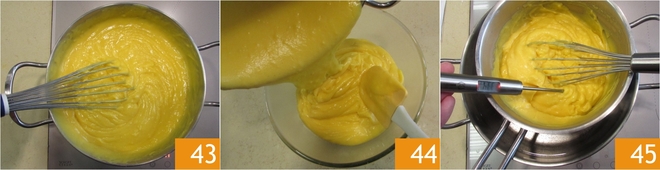
Return the saucepan to the heat and stir continuously until the cream reaches the first boil and begins to form lines 43. At this point, turn off the heat and pour the cream into a bowl 44 that you will immerse in a larger bowl filled with ice water. While waiting for it to cool, stir occasionally to prevent a skin from forming on the surface; the consistency should be smooth and creamy, not compact 45. Once cold, transfer the pastry cream to a piping bag without a nozzle and refrigerate.
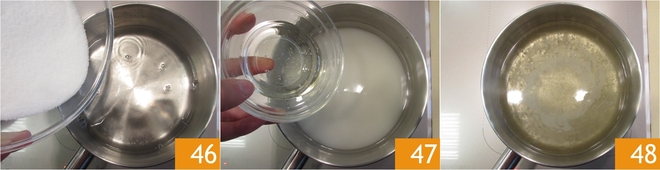
To prepare the syrup, pour the water into a saucepan along with the sugar 46 and glucose 47. When the syrup begins to bubble, give it a stir and wait for it to reach a full boil 48. At this point, turn off the heat and remove the saucepan to prevent the evaporation of the aqueous part.

Once the syrup has reached room temperature, add the alchermes 49 and mix 50. When ready to use, the syrup should have a temperature between 86°F-95°F, so heat it slightly and pour it into a bowl 51.

Take the now cold hemispheres and make a cut at the base with the tip of a small knife 52. Then, insert your thumb into the slit to slightly widen it 53 and dip them into the syrup 54. You can check that you have added 0.4 oz of alchermes for each hemisphere by weighing them on the scale after soaking.

Once they are all soaked, insert about 0.2 oz of pastry cream into the slit of each hemisphere 55, then add another 0.2 oz on the surface, for a total of 0.4 oz each 56. Finally, pair the hemispheres two by two so that the base matches and a bit of cream comes out of the sides 57.

When they are all ready 58, roll the peaches in granulated sugar, covering only the sides 59. Decorate your Prato peaches with a piece of candied orange peel, as if it were the stem 60!