

Caprese macarons
The caprese in a sophisticated appetizer format, these caprese macarons stand out for their colors: red meringues, white cream with green basil.
- Difficult
- 33 min
- Kcal 134
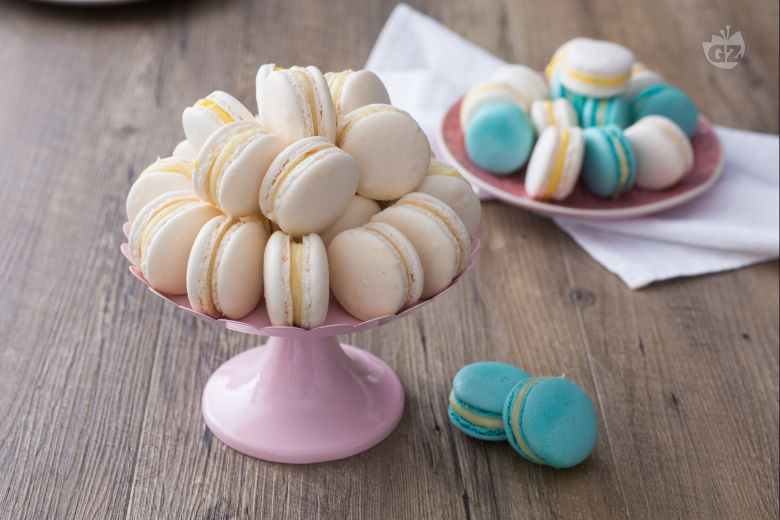
French macarons bring an air of elegance and fun to any table with their colorful shells and fancy fillings. These delicate cookies have a well-earned reputation for being a bit of a challenge—but that's part of the fun. Made from a careful blend of egg whites, almond flour, and sugar, these meringue-based pastries stand out for their crispy exterior that gives way to a tender, moist center. And you know, there's something special about the visual contrast—a brightly colored shell with a creamy inside—that makes each bite as pretty as it is delicious.
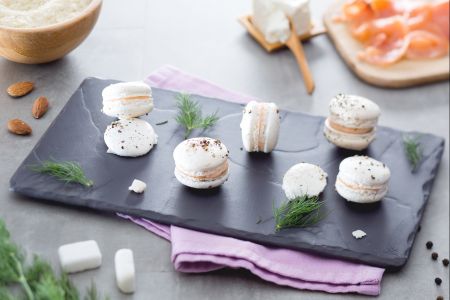
While the classic macaron recipe uses a smooth white chocolate ganache, creative bakers like to mix things up with fillings like mascarpone and red currant cream, or even a tangy salted caramel. Some folks go savory, adding things like salmon and dill for a surprise twist. All these variations keep the spirit of French macarons alive, always aiming for that perfect balance between crispy shell and creamy filling.
Mastering homemade macarons might seem intimidating at first. But honestly, a few good macaron baking tips can make things way less scary. Chef Roberto Rinaldini, for example, swears by precision and taking your time—no rushing, just letting each step get the attention it needs. That's why, seriously, so many people end up hooked on making these treats: every batch is a little adventure, and the results are really worth it.
The best part might be coming up with your own macaron filling ideas and playing with different colors to get just the right look. Even if you stick to a more easy macaron recipe, you still get that great combination of sweet and tender in each bite. Really, a tray of these little pastries can make any day feel a bit more special—they're the kind of thing you set out when you want to impress, but also just to enjoy with friends. Whether you're going traditional or trying something totally new, the world of macarons is full of golden surprises and a whole lot of flavor.
With each successful batch, you get to savor a piece of French culinary artistry that's as fun to make as it is to eat. Can't go wrong with that.
You might also like:

To prepare macarons, it is preferable that the egg whites are "aged," which means separated from the yolks a day before and stored in the fridge, in a bowl covered with cling film with slits, to let the moisture out. They should then be used at room temperature. To make the shells, pour the powdered sugar and almond flour into a bowl 1. The almond flour must be very fine, if not, you can sift it 1-2 times. Mix the two powders with a whisk or a spoon 2. These two elements together will form the tpt, in French tant-pour-tant, which means powdered sugar and almond flour used in equal parts. Insert only 45g of the egg white dose into the tpt (at a temperature of 68°F) 3.

Mix with a whisk 4, until you obtain a creamy consistency free of lumps 5. Set aside and start making the syrup. Pour the water into a saucepan first 6,

then the granulated sugar 7 and heat it on high flame. Pour the remaining 42.5g of egg whites into the bowl of a stand mixer and turn it on only when the syrup starts to boil. As soon as the syrup reaches a temperature of 344°F 8, reduce the speed of the stand mixer and pour it in a stream over the whipped egg white 9.

Continue to whip until the mixture reaches 122°F. The egg white should be stable and glossy 10. Now incorporate the egg white into the first mass; to do this, take 1/3 and add it to the almond mixture 11. Mix gently from bottom to top. Then incorporate the remaining egg white in another 2 parts 12. This is a rule that applies to all recipes; the softer mass should always be incorporated into the harder one.

Once you have incorporated all the egg white, proceed with the actual macaronage, then mix vigorously to give the mass an elastic and glossy structure. The mass should flow and remain on the spatula 13. Transfer the mixture into a piping bag fitted with a plain 12mm nozzle 14. Squeeze out the mixture, creating mounds about 1 inch wide, trying to make them all the same size and spaced apart 15.

After creating all the mounds 16, bake your shells in a static oven at 302°F for about 15-18 minutes. This varies depending on how many trays you bake in the oven and the type of oven you have. While the macarons are baking, make the white chocolate ganache, so first, finely chop it 17 and transfer it to a rather narrow container with high edges to facilitate emulsification and prevent air from entering. Pour the liquid cream into a saucepan and add the vanilla bean seeds 18.

Bring the cream to a boil and as soon as it starts to boil, pour 1/3 into the container with the chocolate 19. Start emulsifying with an immersion blender 20 and add half of the cream again 21.

Emulsify and add the remaining cream. Once you have obtained a smooth ganache, add the softened butter 22 and emulsify once more with the hand blender 23. At this point, transfer to a shallow dish 34,

cover with cling film in contact 25 and let crystallize in the refrigerator for 2 hours at 39°F. As soon as the macaron shells are baked, remove them from the oven 26 and let them cool completely. After 2 hours, transfer the ganache into a piping bag fitted with a plain 10mm nozzle. Turn over only half of the macarons so that the one next to it will remain turned over 27.

Fill the just turned shells with the ganache 28. The filling should be abundant and weigh about 1/3 of the macarons. Close by overlapping the corresponding shell over the ganache 29. Transfer to a tray and let rest in the refrigerator for at least 6 hours covered with cling film before serving your macarons 30.