
Spelt focaccia
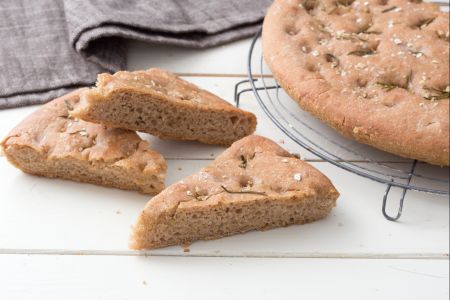
The spelt and rosemary focaccia is a savory leavened bread, perfect to enjoy as it is or to fill for a tasty snack!
- Average
- 2 h 5 min
- Kcal 439
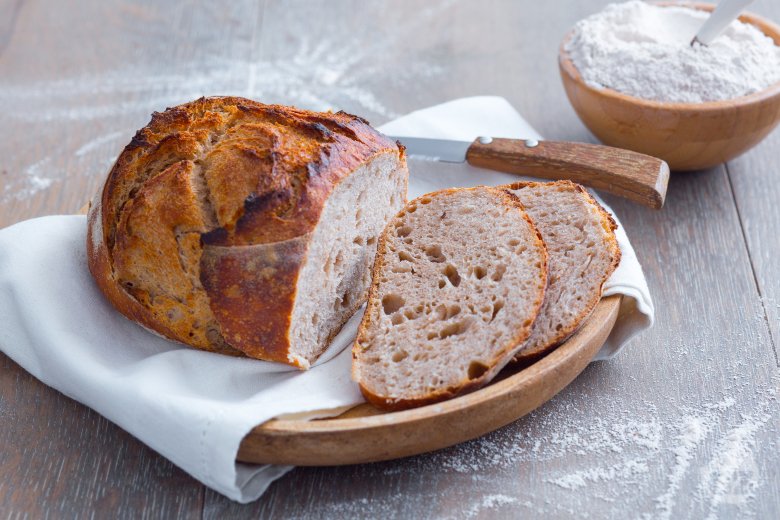
Spelt bread is really a beloved staple in central Italy, especially in regions like Umbria and Tuscany, where farro has been cherished for, like, centuries. Seriously good. This spelt bread recipe totally captures the heart of traditional Italian baking with its tender crumb and a crispy crust—achieved through a perfect blend of natural sourdough (lievito madre) and just a touch of brewer’s yeast (lievito di birra). The process? Requires patience and skill. And look, the highly hydrated dough needs careful folding and long resting times to really, really develop its full flavor.
Italians know that the best moist texture comes from respecting these stages. Honestly, it's about letting those ancient grains transform into something earthy and golden. The aroma of spelt bread baking is captivating—filling the kitchen with that rustic scent of farro. You only get this taste with authentic Italian spelt flour baking. For real. Every loaf tells a story. Sometimes it's more open and airy, other times dense, but always with a chewy, satisfying bite. Leaves you craving more.
Unlike typical sandwich bread, this is, well, the kind of loaf that pairs perfectly with a hearty lunch, a drizzle of olive oil, or alongside a comforting bowl of soup. Thing is, some Tuscan bakers jazz up their bread with whole grains or seeds for added flavor and crunch. But the core of the spelt bread recipe? Simplicity. Letting the farro shine. Baking this bread at home is a real adventure in patience. But I gotta say, the reward is immense when you see that golden crust crack open.
With each bite, you savor tradition and care. Seriously, the heart of homemade spelt bread graces family tables across central Italy. It's both light and filling—ideal for anyone seeking the taste of ancient grain bread. Pretty simple. It's a great journey into Italian artisanal baking, offering a slice of history with every bite. Connects you to the heart of Italian culinary tradition. Cannot go wrong with that.
You might also like:
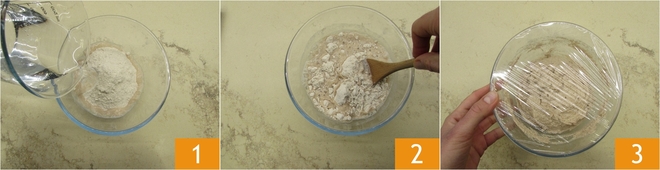
To prepare spelt bread, start with autolysis: in a bowl, pour the spelt flour and water 1, mix with a wooden spoon 2, until you obtain a homogeneous mixture. Cover with plastic wrap and let it rest for an hour 3. This process allows the flour to better absorb the water and develop a better gluten network.
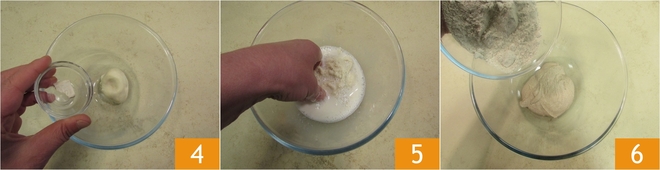
Let's move on to the dough: in a bowl, place the sourdough and fresh yeast 4. Add part of the water and soften everything with your hands 4, there is no need to dissolve them completely. In another large bowl, pour the mixture obtained from autolysis 5, the spelt flour 6, and Manitoba flour.
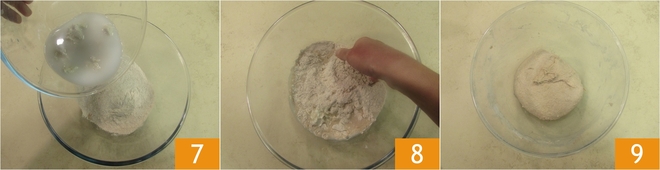
Add the dissolved yeasts in water 7 and the remaining water. Knead in the bowl with your hands for about 5 minutes 8 until you obtain a homogeneous and elastic dough 9.
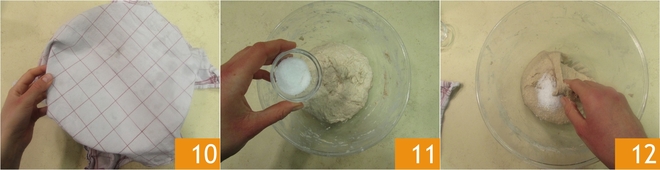
Cover with a dry and clean kitchen towel 10 and let it rest for 10 minutes. After this time, add the salt 11 and work for another 5 minutes to let it absorb completely 12.
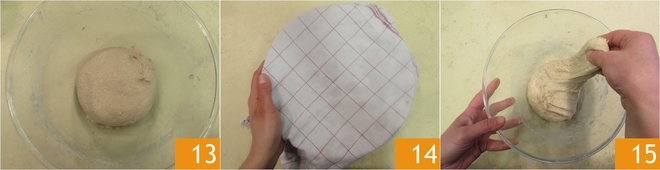
You should reach a point where you no longer feel the salt grains when handling the dough 13. Cover again with the towel 14 and let it rest for another 15 minutes 14. Now you can start with the "four folds" to give strength to your dough and make it smooth: lift one edge of the dough 15 and bring it towards the center.
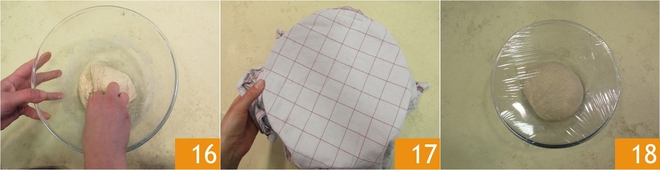
Repeat this movement 4 times to grab the edges of the dough, rotating the bowl 16. Cover with a towel 17 and let it rest for another 15 minutes. Repeat this operation 3 times at 15-minute intervals, always making 4 folds in the dough. After making the folds, cover with plastic wrap 18.
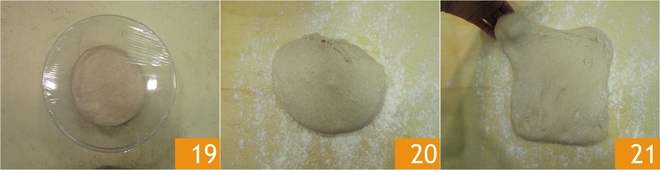
Let it rise for an hour and a half at room temperature. Then transfer the dough to the refrigerator and let it rise for a minimum of 12 hours and a maximum of 18 hours. Retrieve the dough and leave it at room temperature for a couple of hours before working with it. 19 Now transfer it to a lightly floured work surface 20. Gently spread the dough with your hands to form a rectangle measuring 14x9 inches 21.
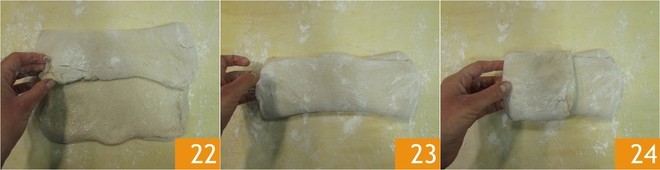
Then fold the top side towards the center 22 and then bring the bottom one over it to make them meet 23. At this point, bring the dough towards the center by folding it laterally first from one side 34 and then from the other.
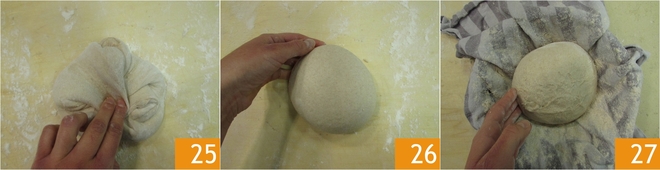
Bring the corners of the obtained rectangle towards the center to get a sort of bundle 25; flip it and round the dough until you get a spherical shape 26. Transfer inside a bowl, measuring 8x3.5 inches where you have already placed a well-floured cloth inside 27.
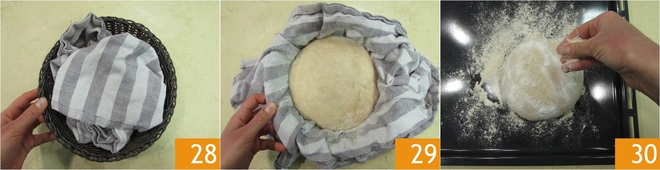
Cover with the edges of the cloth 25 and let it rise at room temperature for 6 hours. At this point 29 transfer the dough by flipping the bowl onto a lightly floured baking tray 30.
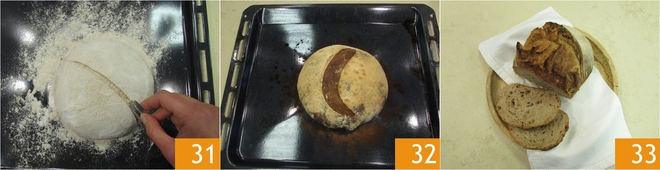
Using a razor blade or a very sharp knife, make a diagonal cut 31. Bake in a static oven at 482°F for 25 minutes, then lower the temperature to 428°F and bake for another 15 minutes. Then remove from oven 32 and let cool before cutting and serving it 33.


