

Rum babà (Rum syrup infused sponge cake)
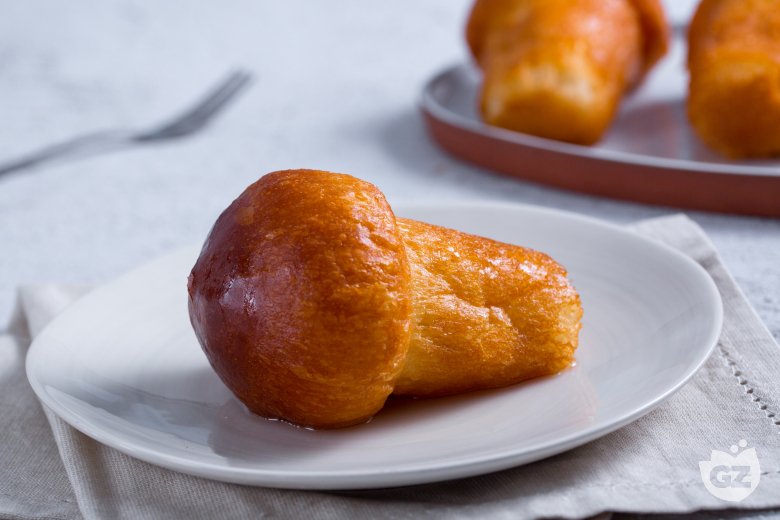
The rum baba is a typical Neapolitan dessert with a soft and spongy dough, soaked with an aromatic liqueur syrup! Here is the recipe to make…
- Average
- 1 h 25 min
The Neapolitan babà isn't just a dessert—it's a real symbol of Naples, with such a rich history. It all started with the Polish 'gugelhupf,' traveled through the fancy courts of France, and ended up in Naples. And look, that's how we got the Neapolitan babà recipe we love today. What makes it stand out? Its super tender, almost moist texture, soaked in rum syrup. Really, really good. Locals? They take this preparation seriously. Precise ingredient temperatures and allowing the dough to rise—those are key. And here's the thing: many families make it a day ahead. It’s so every drop of that sweet, golden syrup gets absorbed. Each bite is like tasting history, wrapped up in a classic treat cherished in Campania for generations.
Now, the traditional babà dessert from Naples? It's all about the perfect balance of sweet and tangy flavors—thanks to the rich rum syrup and soft, spongy base. You know, unlike other Italian dessert recipes, babà is light yet flavorful. Really not plain. You'll spot these great domed cakes in Neapolitan pastry shops, sometimes plain, and other times topped with whipped cream or fresh fruit. And look, there's even a savory twist and the French-inspired Savarin. Which is great. It shows its culinary versatility and deep cultural roots. In Naples, babà is more than a dessert—it is a baking culture icon. Getting the details right? Pretty much about preserving a tradition that connects families, history and a city that loves its sweets. The Neapolitan rum cake is more than just a dessert; it’s a slice of Naples on a plate, bringing a little celebration with every serving. Whether at a family gathering or as a sweet treat on a leisurely afternoon, this dessert shows the heart of Neapolitan hospitality and culinary heritage. So, it’s a must-try for anyone visiting the beautiful city of Naples. For sure.
You might also like:
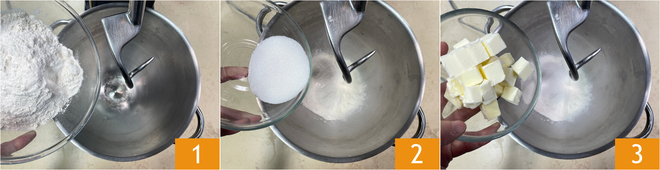
To prepare the babà, you need to place 3 eggs in the freezer the night before: we recommend cracking them and placing them in silicone molds to make them easier to extract. The butter and the remaining eggs should be cold from the fridge. Pour the flour 1 into a stand mixer, along with the sugar 2 and cold butter cut into pieces 3.
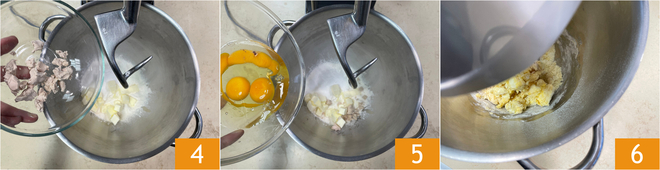
Add the crumbled yeast 4 and 3 cold eggs from the fridge, a little at a time 5. Start kneading at medium-low speed: the dough should completely absorb the eggs 6.
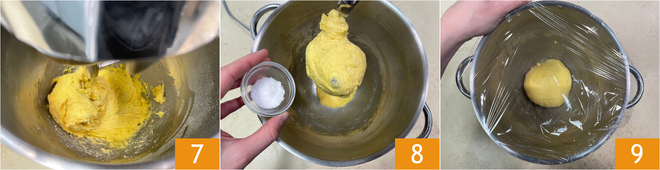
Add the salt while the stand mixer is running 7, then knead for another 5-10 minutes or so. Once the dough has formed 8, remove it from the hook and shape it into a ball, then cover with cling film and let it rise for about 2 hours, away from drafts. It should double in volume.
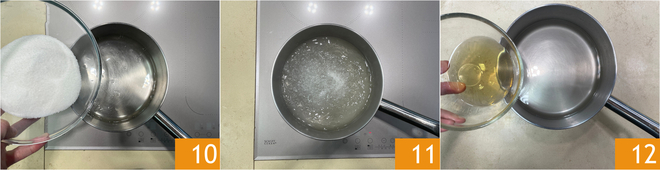
In the meantime, you can prepare the syrup which needs more resting, and which will be used to soak the babà before serving them. Pour the water and sugar into a small saucepan 10 and bring to a boil. Turn off the heat and let it cool completely. Only when it’s cold, can you add the 70° proof rum 12. Keep the syrup aside in the fridge, covered with plastic wrap.
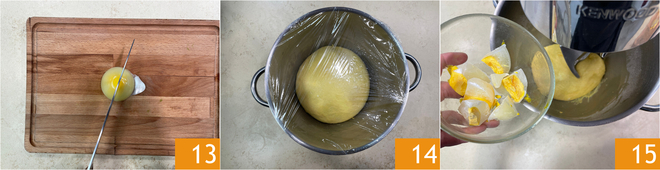
Meanwhile, resume working with the dough: take the 3 eggs from the freezer and divide them into parts, so you can add them to the stand mixer a little at a time 13. At this stage, patience is crucial: place the dough that has doubled in volume in the stand mixer 14, then start mixing at low and then medium-low speed. Add a piece of frozen egg at a time to let it be completely absorbed before adding another 15.
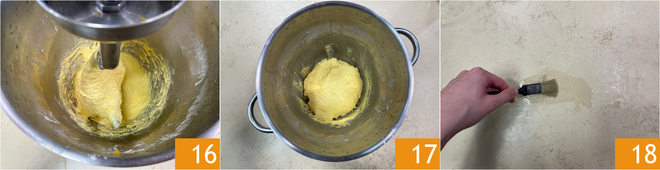
It will take at least 30-40 minutes for all the eggs to be fully incorporated 16, we suggest not to rush at this stage. At most, you can occasionally increase the speed of the stand mixer, but the dough should not get excessively warm, otherwise, the gluten network will not form properly. Once the dough is ready 17, oil the molds of about 70 g capacity, then lightly oil the work surface 18.
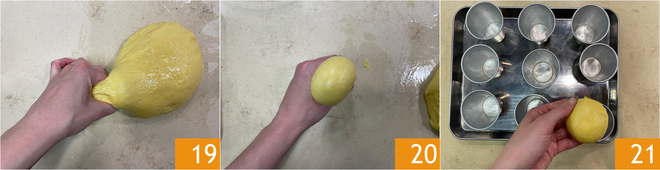
Turn the dough onto the work surface, give a few reinforcement folds, and then, to make a piece of about 30-40 g at a time, pull a piece of dough with one hand 19 and squeeze it to make it come out between the index and thumb, with a closed hand 20. Place each piece into the oiled molds, which you will have placed on a tray 21.
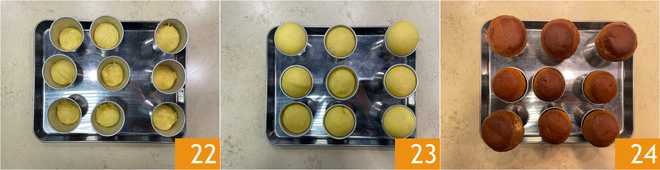
With these quantities, you will get 10-12 babà 22. You will then have to let them rise without covering them, in the off oven with the light on (about 79°F) until they rise above the mold edge 23. Bake in a preheated static oven at 392°F, for about 15-20 min. Remember that every oven is different, so you can adjust the timing with a first batch of 2-3 babà to better know the timing for the subsequent ones. Once baked, let them cool at room temperature 34, then remove them from the molds and let them dry in the air even for 34 hours.
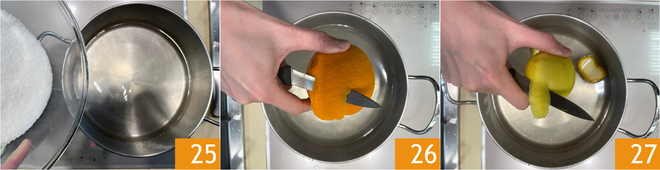
To make the punch that will be used to soak the babà, pour water and sugar into a large saucepan 25 and bring to a boil. Turn off the heat and flavor with orange 26 and lemon zest 27.
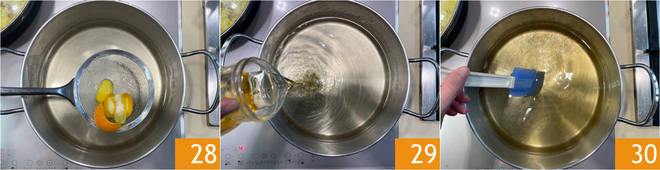
When the syrup has cooled down, remove the peels 28 and pour in the 70° proof rum 29, then stir 30.

Transfer the syrup you had prepared earlier into a squeeze bottle 31. Immerse the babà in the punch 32 and let them soak for 2-3 minutes 33.

Gently squeeze the babà and let them drain on a wire rack with a tray underneath to collect the excess liquid 34. Before serving, drizzle each babà with the prepared syrup 35 and it will be ready to enjoy 36!