

Salmon trout with orange
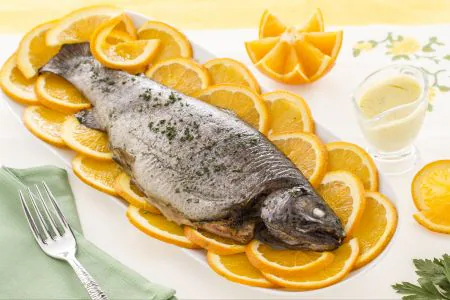
The salmon trout with orange is a delicate and very refined fish dish, to prepare for a special occasion or a formal dinner.
- Easy
- 50 min
- Kcal 408
Alright, so here's the deal: the Lingotto di Mergozzo is like northern Italy in a dish. Seriously good. It shows off this amazing trout from Lake Mergozzo—Piedmont's little secret. I mean, this fish? It is known for its mild taste and tender texture. But you don't see it everywhere, even though it’s really, really good.
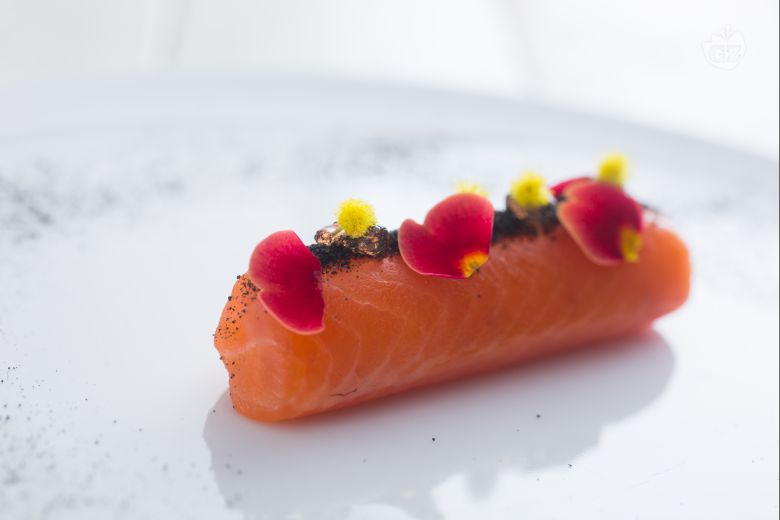
So Chef Marco Sacco, the genius behind Piccolo Lago, came up with something special. He turns the fillet into a gold bar—pretty cool, right?—using a dry marinade of salt and just enough sugar to keep it moist with a hint of sweet flavor. And here's the thing, the homemade smoking process is the star. Beech sawdust adds this subtle herby smell. Nothing too heavy—which is great.
This Mergozzo specialty? It’s not rushed, you know. Little touches make it pop. Like raspberry gelatin drops for a tangy kick, edible flowers for color, and black bread powder for a crispy finish. Every bite of this Italian smoked trout appetizer is like a mini-tour of Lake Mergozzo. So, so good. Balancing tradition with a splash of artistry, it stands out compared to other regional Italian dishes. Refined and just a bit unexpected, for real.
And look, even with all that flair, it stays focused on the fish—clean, fresh, dressed up perfectly for a fancy party or special meal. Cannot go wrong. It shows that with thoughtful ideas and real respect for ingredients, something like lake trout can turn into a true centerpiece of gourmet Italian recipes.
Chef Sacco’s approach? It doesn't just highlight local ingredients but also mixes in fancy techniques. This dish is a beautiful blend of traditional and modern, making it a must-try for anyone diving into Piedmont's culinary wonders. Pretty much, it’s a masterpiece you’ll want to explore. For sure.

To prepare the Mergozzo gold bar, first, focus on marinating the fish. In a bowl, pour the sugar and coarse salt 1 and mix everything. Spread the mix over the trout fillet with skin 2, cover with plastic wrap and refrigerate for 6 hours 3. Now, if you wish to make the black bread powder needed for decoration, this is the right moment; you'll find the box at the end of the recipe.

After the marinating time, rinse the fillet under running water 4 and dry it thoroughly 5 before transferring it to an oven rack 6.

In a baking tray, pour the beech sawdust, a sprig of rosemary, 2-3 bay leaves, a broken sprig of sage, 3 crushed garlic cloves 7. Mix everything with your hands and burn with a blowtorch (8-9). Move it around a bit with tongs and transfer the tray to the bottom of the oven. Place the fillet on the rack positioned at the top of the oven and let it smoke for 2 hours with the oven turned off.

At this point, take back the trout fillet, trim it 10, then cut a slice and then pass the knife between the flesh and skin to remove the latter. From the slice, cut out precise rectangular shapes 11. Wrap each one individually in plastic wrap 12,

roll it on the work surface and close it like a candy 13. Then place in the fridge for about an hour. Meanwhile, also prepare the jelly: pour the vinegar into a saucepan and heat it. In another bowl, mix sugar and agar-agar powder 14; then add them to the hot vinegar 15

and let it dissolve by moving the saucepan on the fire or mixing with a whisk 16. Let it boil for a few moments. Pour the liquid obtained into a small tray 17 and let it set for 1 hour at room temperature. After this time, make it fluid again using a hand whisk 18 and store inside a pastry bag in the refrigerator.

At this point, take back the gold bar 19, push it out of the plastic wrap 20, and place a bit of black bread on the surface 21.

Also place 4 drops of jelly on top 22. Decorate with edible flowers 23 and place a bit more black bread around 34. The Mergozzo gold bar is ready to be served.

To prepare the black bread, first pour the balsamic vinegar into a bowl and add the activated charcoal 1. Stir with a teaspoon to dissolve it 2. Crumble the sandwich bread inside 3

and wait until the liquid is absorbed 4. Transfer to a baking sheet lined with parchment paper 5, spread it using a spoon 6, and let it dry for 6 hours at 140°F in a static oven.

Once it is well dried, take it out of the oven 7 and let it cool. Then transfer it inside a blender with blades 8 and reduce it to powder 9.